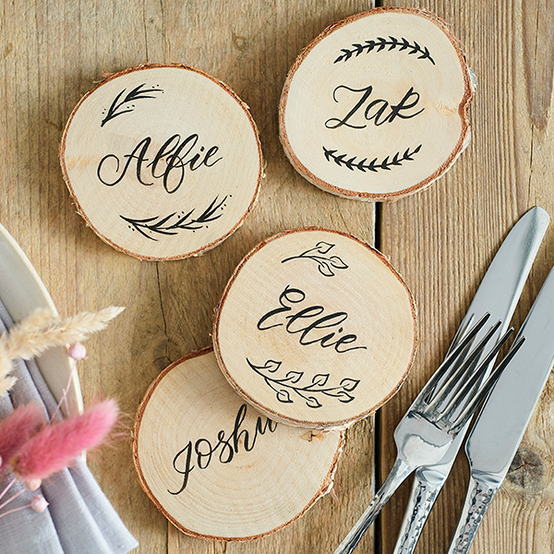
How to Make Modern Calligraphy Place Cards
Learn how to make modern calligraphy place cards that add a personal, elegant touch to your next event.
Perfect for weddings or special gatherings, these DIY place cards are easy to customise with names, floral details, or your own unique illustrations—making each one as individual as your guests.
Project and instructions by Sue Smith
You will need




You Will Need
* Natural Wooden Slices 8cm
* Modelcraft Extra Flexi Slim-Line Sanders
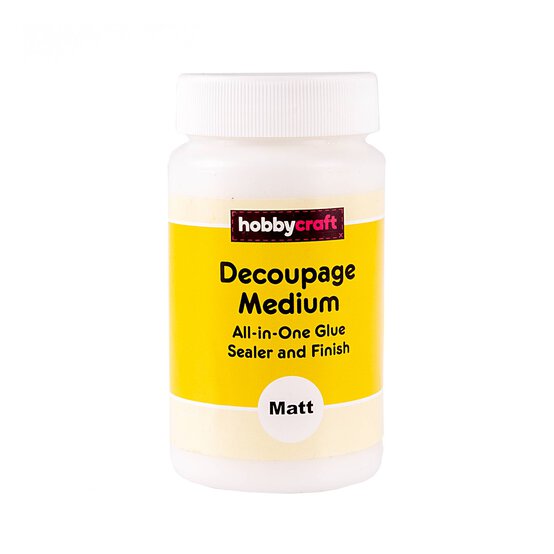
* Matt Decoupage Medium 250ml
* Decoupage Silk Brushes
* Tracing Paper Pad A4
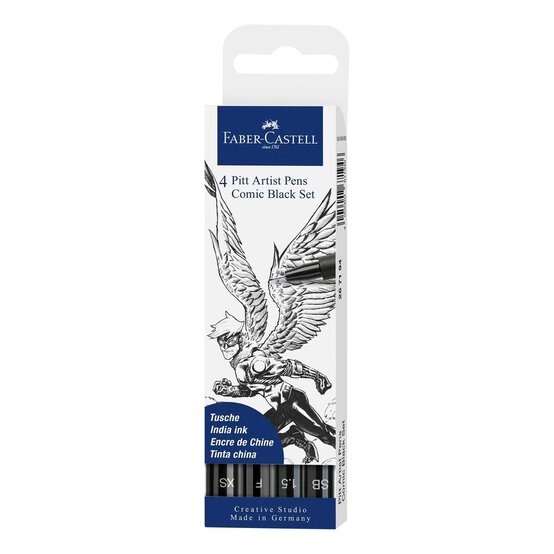
* Faber-Castell Black Pitt Artist Pens
* Printed Supplied Brush Calligraphy Alphabet Template
* Pencil
* Scissors
Begin by unwrapping the stack of wood slices.
Prepare each slice by sanding down the upper surface only, making it smoother and easier to write on. Use the coarse sander first, and gently sand in circular motions flowing the grain of the wood.
Repeat with the middle grade sander, and finish off using the finer grade sander.

Coat each prepared wood slice surface with a thin layer of Matt Decoupage Medium, using a wide brush.
Allow to dry.
Then, add a second coat, and allow to dry completely.

Use your printed supplied template and a pencil to trace each name required onto tracing paper.
Top Tip: Draw a baseline first, and use this as a guide when tracing each letter. This will help keep all the letters level, and at the same slant angle.

Transfer the names onto the wood slices by scribbling pencil on the reverse.
Cut out each name before rewriting in position across the centre of the wood. A faint penciled name will be a good guide for brush lettering over the top using the Faber-Castell Pitt Artist Pen Brush (B).
Top Tip: Create a level writing surface to rest your hand and forearm when writing onto the wood slice.
Simply use the tracing paper pad up-side-down butted-up against each wood slice. Add a little pressure to the brush pen on all the downward strokes, creating a slightly thicker line.

Decorate the place settings by drawing simple foliage designs around the names.
Here are three different ideas all drawn using the Faber-Castell Pitt Artist Pen Soft Brush (SB).
Top Tip: Practise drawing the decorations onto tracing paper over the names to achieve a good balanced design.

Create a neat foliage decoration above and below the name.
Draw the stem line first, then create the little leaves by simply pressing the side of the nib of the pen down onto the wood, close to the stem.

Another alternative decoration is a grassy stem below the name, with a smaller stem towards the top left.
Loosely draw the grass design first. Then, add a few tiny dots filling the gaps.

Drawing an open leaf design is another lovely way to decorate the place settings.
Again, draw the stem first. Add little leaf stems branching out at regular intervals. Then, draw the leaf shape around the tip of the leaf stems, leaving tiny gaps.